
General
Mini Shai-Hulud and the Rising Risk of Open-Source Supply Chain Attacks
Open-source software has become the foundation of modern digital infrastructure. From cloud applications and AI systems to automation platforms and enterprise portals, businesses depend on external packages to build faster and operate smarter.
Mini Shai-Hulud and the Rising Risk of Open-Source Supply Chain Attacks
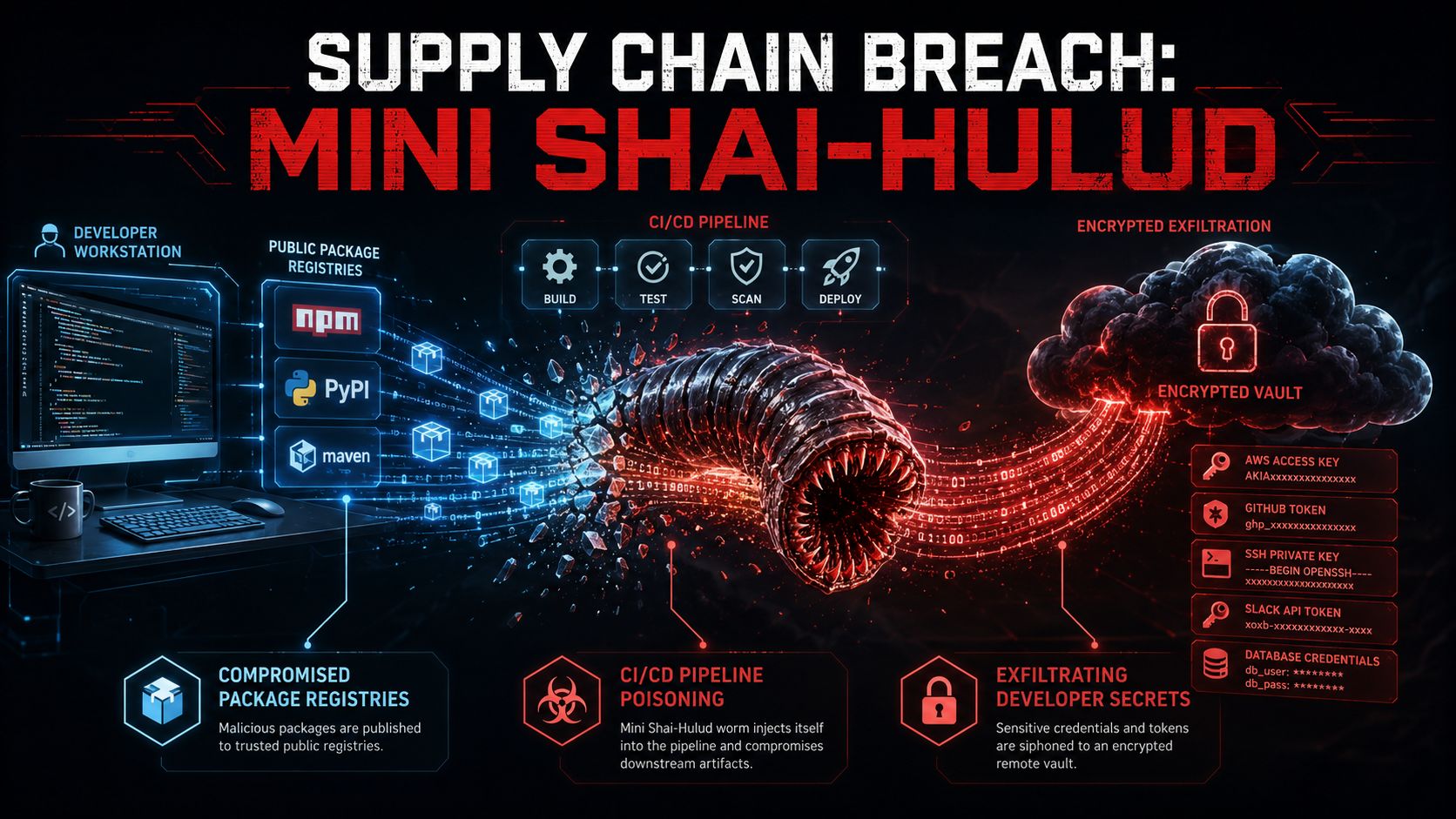
But this speed comes with a serious risk. The recent Mini Shai-Hulud supply chain attack shows how attackers are now targeting the software components that developers trust every day.
Instead of attacking a company directly, threat actors compromise public package registries, developer accounts, and automated build environments. Once a poisoned package is installed, it can silently collect credentials, cloud tokens, SSH keys, and CI/CD secrets.
Executive Summary
Mini Shai-Hulud is a reminder that software supply chain security is no longer optional. Enterprises must protect developer machines, CI/CD pipelines, internal repositories, cloud credentials, and third-party dependency workflows with the same seriousness as production infrastructure.
Why This Attack Matters for Modern Enterprises
Most modern applications are not built from zero. They are assembled from thousands of packages, plugins, libraries, frameworks, and nested dependencies.
Developers use package managers such as PyPI for Python, npm for JavaScript, Go modules for cloud-native applications, RubyGems for Ruby, and Packagist for PHP. Each ecosystem improves productivity, but each also creates a separate attack surface.
Mini Shai-Hulud reportedly targeted developer credentials and CI/CD environments by abusing trusted package ecosystems. This type of attack is especially dangerous because malicious code can run during installation before normal security checks detect suspicious behavior.
Main Security Challenges in Open-Source Development
1. Polyglot Environments Create More Entry Points
Enterprise software teams rarely use only one programming language. A business may use Python for AI, JavaScript for web interfaces, Go for backend services, PHP for business tools, and Ruby for internal applications.
This multi-language setup increases the number of package managers, dependency chains, and developer workflows that must be secured.
A compromised package in one ecosystem can expose credentials that attackers use to move into another system. For example, a small infected PHP package could expose a token that gives access to cloud infrastructure or private repositories used by Python or Go teams.
2. Developer Machines Are High-Value Targets
Developer laptops often contain SSH keys, API tokens, GitHub credentials, environment variables, package manager tokens, and cloud access keys.
If malware reaches a developer machine, it can quietly search for these secrets and send them to attackers. Once credentials are stolen, the attacker may not need to break into the network. They can simply log in using valid access.
3. CI/CD Pipelines Can Spread the Damage
CI/CD pipelines are designed to automate software delivery. They build, test, package, and deploy applications whenever developers push new code.
To do this, they often hold powerful credentials. These may include container registry access, cloud deployment keys, database secrets, and production environment tokens. If attackers compromise a CI/CD workflow, they may inject backdoors directly into trusted software builds.
Key Insight: The weakest point in enterprise software security is often not the production server. It is the trusted development pipeline that creates and deploys the production software.
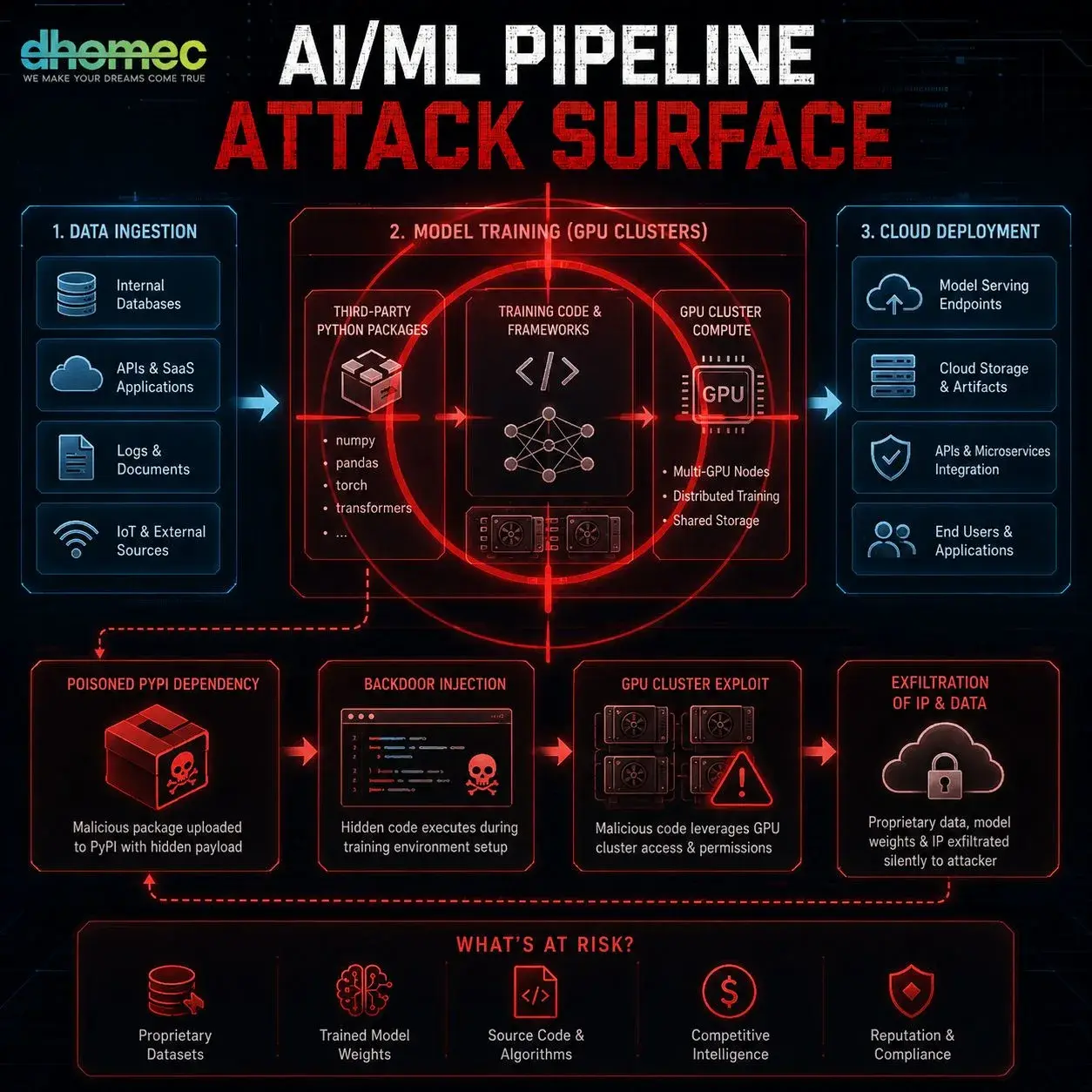
Why AI and Machine Learning Teams Are Especially Exposed
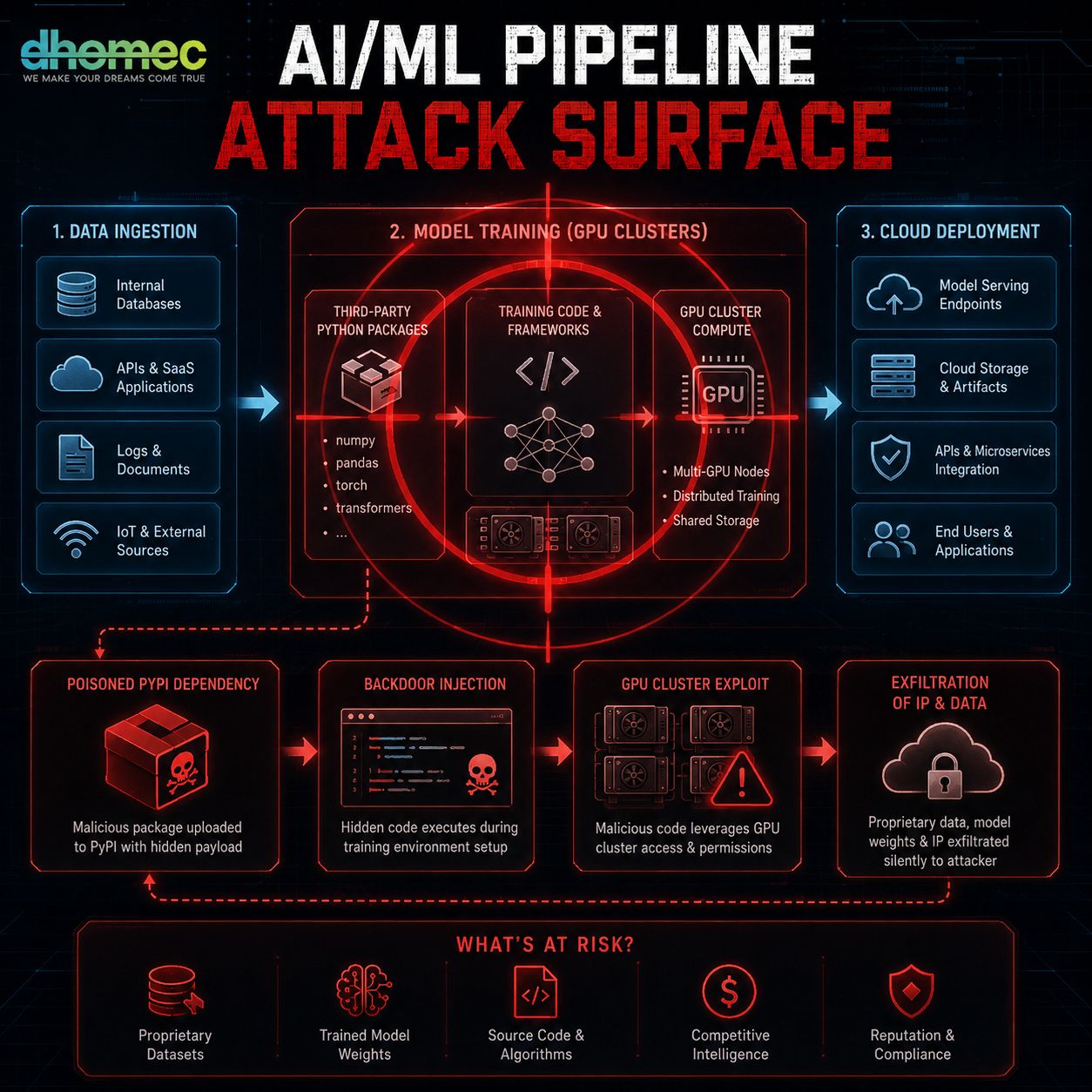
AI development pipelines are attractive targets because they often combine fast experimentation with sensitive data access.
Data scientists and machine learning engineers frequently install new Python packages to test models, accelerate training, or connect to cloud resources. If these packages are not reviewed carefully, malicious code can enter the AI workflow.
A compromised AI package may expose training data, model files, cloud storage buckets, GPU clusters, experiment logs, and proprietary research. For enterprises, this is not only a cybersecurity issue. It is also an intellectual property and business continuity risk.
Manual Dependency Handling vs. Secure Open-Source Governance
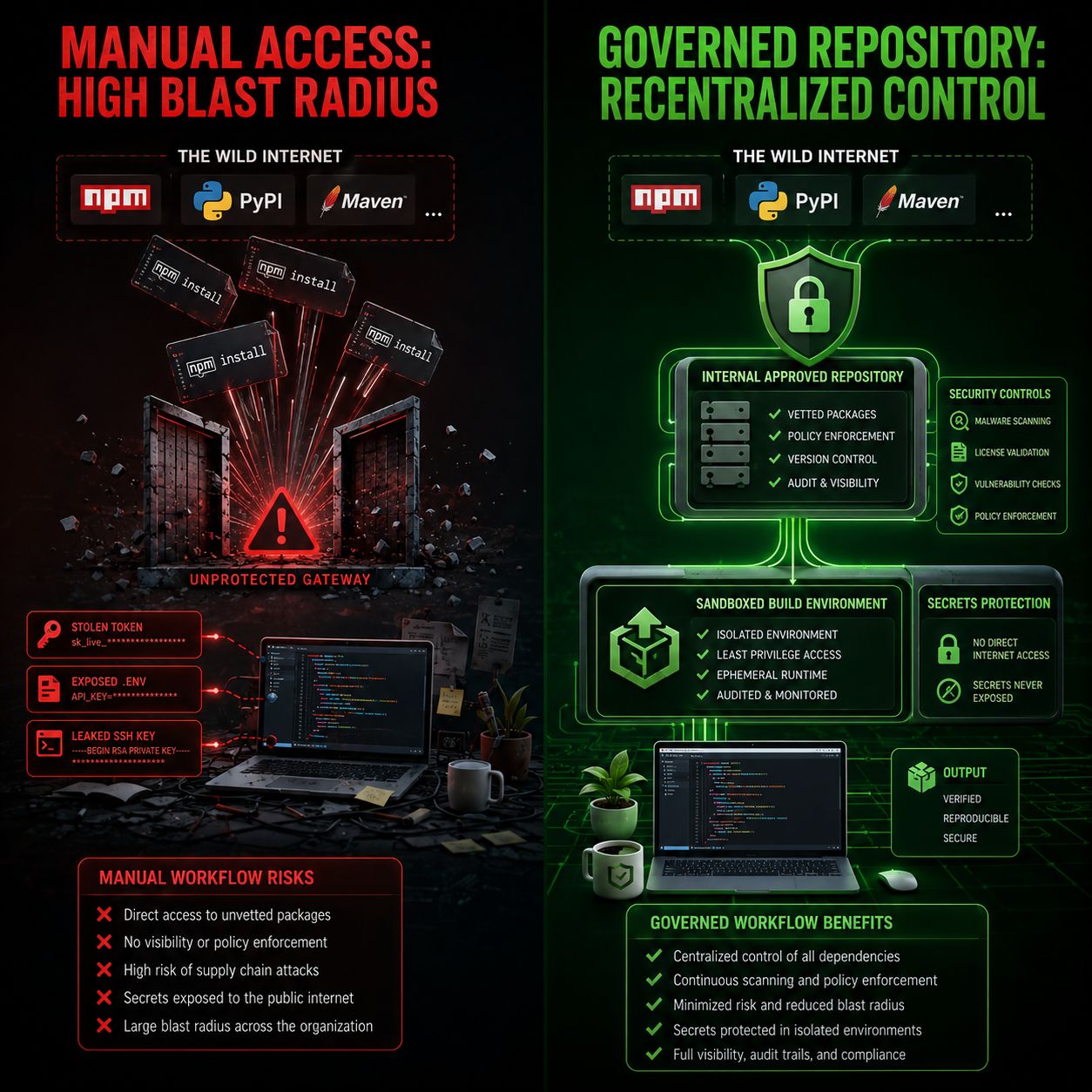
Security Area Manual Approach Governed Approach Package Downloads Developers install directly from public registries. Packages pass through internal approved repositories. Security Review Review depends on individual developer awareness. Automated scanning and policy checks are applied. Credential Safety Secrets may remain exposed in local or CI environments. Secrets are isolated, rotated, and monitored. Incident Response Teams manually search where bad packages are used. SBOMs help locate affected software quickly. Business Risk High risk due to low visibility and inconsistent controls. Reduced risk through centralized governance.
What Enterprises Should Do Now
The Mini Shai-Hulud incident shows that enterprises need stronger controls over external code. Security teams cannot rely only on known vulnerability databases because new malicious packages may not appear in those databases immediately.
Companies should combine dependency approval, runtime behavior analysis, internal package repositories, SBOM tracking, and CI/CD hardening.
Use internal package repositories instead of allowing direct downloads from public registries.
Scan packages before approval using security tools that check both vulnerabilities and behavior.
Create and maintain SBOMs for all critical applications and services.
Protect CI/CD credentials with least-privilege access and regular rotation.
Monitor installation behavior for suspicious actions such as reading SSH keys or environment variables.
Train developers and AI teams to verify packages before using them in sensitive environments.
Isolate build environments so compromised jobs cannot easily access production credentials.
Final Takeaway
Open-source software remains essential for innovation, but blind trust is no longer safe. Attackers know that developer machines, package registries, and CI/CD systems are connected directly to valuable enterprise assets.
The best defense is not to stop using open-source software. The best defense is to govern it properly, monitor it continuously, and reduce the blast radius when a compromised dependency appears.
Build Safer, Smarter Enterprise Infrastructure
Dhomec Solutions supports enterprises with reliable automation, access control, loading bay, entrance management, and smart facility solutions designed for long-term operational performance.
As facilities become more connected and software-driven, businesses need technology partners who understand both operational reliability and infrastructure security.
See Also
Recommended articles in General
Automatic Gate Installation in Hyderabad: A Complete Guide for Homes, Apartments, and Businesses
Automatic gates are no longer just a luxury feature. For modern homes, gated communities, offices, warehouses, and industrial properties, they have become an important part of security, convenience, and smart access control.
SpaceX IPO Filing Reveals Massive AI Data Center Expansion and Billion-Dollar Anthropic Deal
A newly revealed IPO filing from SpaceX has uncovered major details about Elon Musk’s expanding artificial intelligence infrastructure ambitions. The document highlights massive investments in AI compute facilities, cloud-scale GPU deployments, and future plans for orbital data centers powered by solar energy.